


Conservation projects
Here you are going to see a few conservation projects that I did during my study in Ireland. Some of them are a group work and some other an indivedual project.

Lord Waterford Estate, Industrial Farming Buildings (Development)
This conservation project was a collaborative between Architect & Architecture Technology. The site has 5 Building where it been named as A, B, C, D, E & F + Site surveyor. Their objectives to create an exact copy of this historical site. The Normans (France) have built it where they has a different way of construction especially at that site. The farm still alive. And it consider as a protected structure.
However, my group was B contain of seven people to survey the building. My task was to do the measurement the heights to help the other partner’s in-group to create the cad drawing. And sketch some of interesting details. Moreover, I took photos of the site from the inside and the outside. See the document to see the photograph that I took.
In this part, we have been assign to develop the site. Therefore, the architect student design a new building then the architecture technology examine the project. In other words, we have to test whether the proposal project is work in term of the construction material and the compellability with the new Irish building regulation.
So, first we had create a report of the existing building. Second, we have designed a new Hourse school
Retrofit The Old Infirmary, Waterford
This retrofitting project was to develop and improve the current states of this protected structure the Infirmary. It been designed in 1785 and it has a great history where it meant to be a Hospital unit then it been modified to be the infirmary in 1895.

Conservation trip
Overview:
In partial fulfilment of the “Conservation Project” module, the class group will undertake a fieldtrip to observe and appraise examples of the Irish built heritage and adjudicate on any contemporary building interventions. Four specific sites/buildings have been selected from various eras of Irish History.
The intention is that each site/building will introduce the student to a diverse level of complexity in terms conservation, consolidation and indeed refurbishment.
Aim of the Project:
The aim of this field trip ios to appraise and offer and informed visual opinion of the success, or lack of, the conservation works which were undertaken at each of the buildings/sites.
Project objectives:
To understand the process of constructing an “informed” point of view through visual observation and reflection.
FOTA House, Cobh, Cork
Fota House was originally built as a modest two storey hunting lodge for the wealthy and powerful Earls of Barrymore. During the 1820s, the house was extensively remodeled by John 'The Magnificent' Smith Barry into an elegant Regency mansion. The sumptuous interiors from tha period have recently been restored to their former glory and give the visitor a privileged look at the best of 18th and 19th Century Irish craftsmanship.
Fota remained in family ownership until the death of Mrs Dorothy Bell in 1975. Since then, the Fota Estate has passed through various phases of ownership involving University College Cork and the Fota Trust. In December 2007, the Irish Heritage Trust took ownership of the house and invested in major restoration and conservation work since then.
You can uncover the fascinating history of the Smith Barry family and their servants in 'Aspects of Fota' - a trio of guide books published by the Irish Heritage Trust and for sale in our shop and here.
Source (http://www.fotahouse.com/)

Front fountain


Front fountain
Charles Fort, Kinsale, Cork
Charles Fort is a classic example of a late 17th century star-shaped fort. William Robinson, architect of the Royal Hospital in Kilmainham, Dublin, and Superintendent of Fortifications, is credited with designing the fort. As one of the largest military installations in the country, Charles Fort has been associated with some of the most momentous events in Irish history. The most significant of these are the Williamite War 1689-91 and the Civil War 1922-23. Charles Fort was declared a National Monument in 1973. Across the estuary is James Fort designed by Paul Ive in 1602. Source (http://www.heritageireland.ie/)


Walking & Hiking
This was one of the most enjoyable part of the trip where we were walking first in the city then we went off to the mounting where we saw a very interesting things which I never be familiar with.


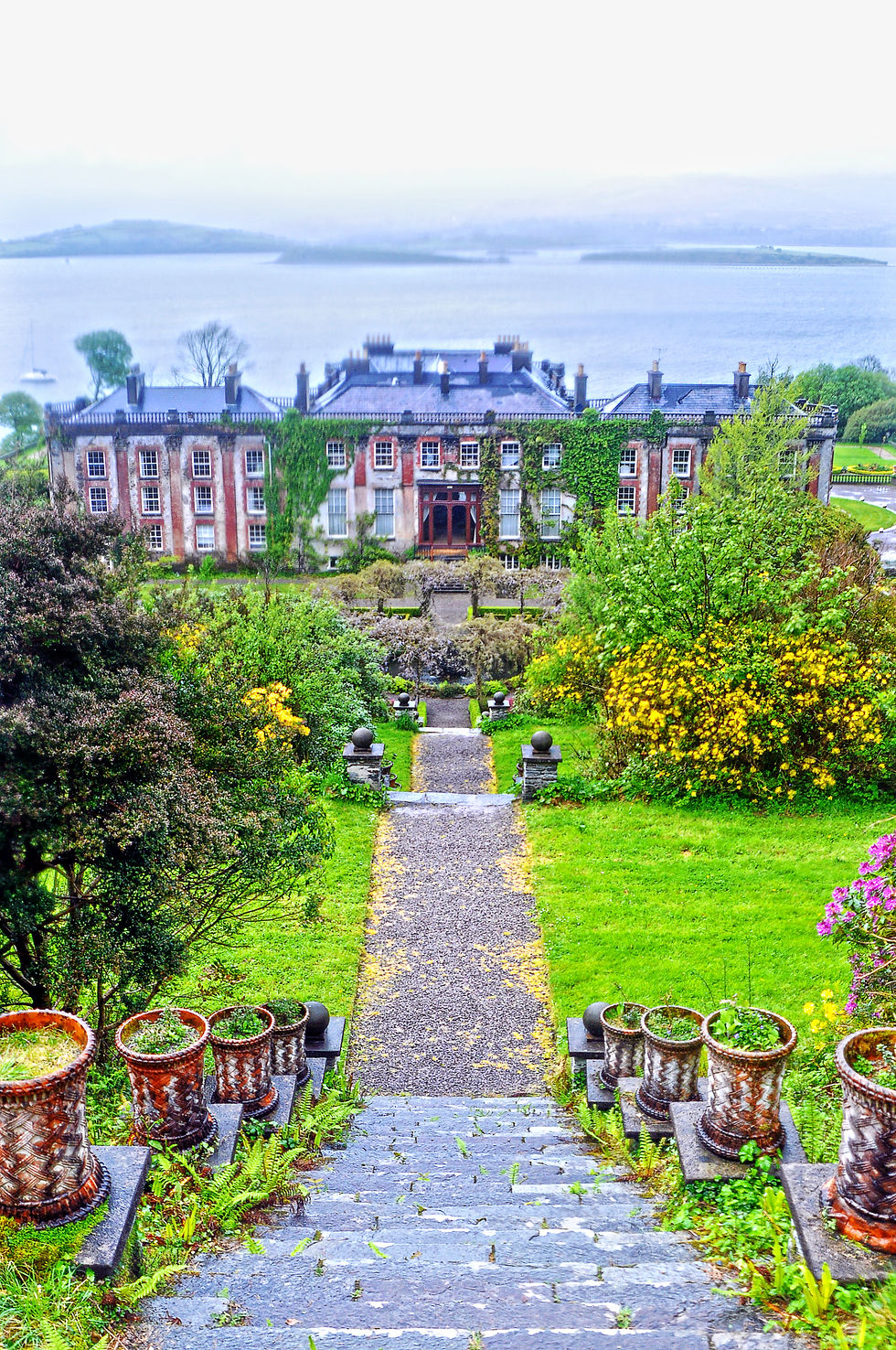
Bantry House & Gardens, Bantry, Co. Kerry
Captain Richard White and his family moved from Limerick to Whiddy Island in Bantry Bay in 1690 and purchased Bantry House (then called Blackrock House) in 1739. Today, the eighth and ninth generation of the family still own, manage and live on the estate.
The original house was a much smaller “Queen Anne” -style building. The second Earl of Bantry, also named Richard White, and his wife Mary O’Brien of Dromoland Castle, Co. Clare, embarked upon a grand tour of Europe and Russia in the 1820s, collecting the furniture, paintings, tapestries, carpets, and artefacts that are still in the house today. It was during these inspiring travels that they came up with their vision for the layout of the garden and the extension of the house with bay windows, the library, two wings, two stables (east and west), five gatelodges, and a walled garden.
More recently Egerton Shelswell-White (8th generation) worked for a time as a teacher at Indian Springs, Alabama in the late 1960s and 70s. He came back to Ireland and inherited the estate on the passing of his mother, Clodagh, in 1978. His 2 oldest children schooled at Indian Springs and still live in the States. Egerton passed away in December 2012 and is survived by his wife Brigitte and 6 children, Edward, Janie, Sophie, Sam, Anna and Julie. Sophie has been running the estate since 2010.
Source (http://www.bantryhouse.com/)


Conservation assignment
This was a visit to a historical village in Bunratty Castle (Irish: Caisleán Bhun Raithe, meaning "Castle at the Mouth of the Ratty") is a large 15th century tower house in County Clare, Ireland. It is located in the centre of Bunratty village (Irish: Bun Ráite), by the N18 road between Limerick and Ennis, near Shannon Town and its airport. The castle and the adjoining folk park are run by Shannon Heritage as tourist attractions.